

A Nancy Meyers living room is one you are still thinking about long after the credits roll: soft cream walls, a deep sofa you could happily disappear into, lamplight instead of a hard overhead glare, and books stacked as though somebody actually reads them.
If you're drawn to this look but aren't sure where to start, below are 12 Nancy Meyers living room ideas to inspire your own, from the sofa shape to choose to making the palette work.
What Makes a Nancy Meyers Living Room?
A Nancy Meyers living room is a room that looks lived in rather than decorated. It is the interior style seen across the films Nancy Meyers has written and directed, from the Hamptons beach house in Something's Gotta Give to Jane's Santa Barbara home in It's Complicated, Rosehill Cottage in The Holiday and the Brooklyn brownstone in The Intern. The rooms share a recognisable set of habits.
- A warm, low contrast palette. Creams, oatmeal, sand, putty and soft greige, with the walls, the upholstery and the curtains sitting only a shade or two apart.
- Generous, softly shaped seating. Deep seats, rolled or gently sloping arms, loose covers that relax rather than pull tight.
- Texture instead of colour. Jute and sisal underfoot, cotton and linen weaves on the sofa, wool throws, wicker baskets, warm oak.
- Lamplight. Table lamps, picture lights and sconces, ideally on dimmers, rather than a single ceiling fitting. The films are famously lit to look like early evening.
- Evidence of a life. Stacks of books, framed photographs, a half finished crossword, flowers in a jug rather than a designer vase.
Nancy Meyers Living Room Ideas
1. Start with a warm white, not a cold one
The most common mistake when copying this look is reaching for a brilliant white. It tends to look cold and a little clinical, particularly in a room that doesn't get much sun.
Choose a white with a drop of yellow, cream or stone in it. Farrow & Ball's School House White, Wimborne White and White Tie are all in the family Beth Rubino has named as her starting points.
Use an eggshell or a soft sheen rather than a dead flat matt on woodwork and joinery. It bounces what light you have back into the room. If you would like more on getting a palette right before you commit, our guide to colour trends for 2026 is a good place to start.
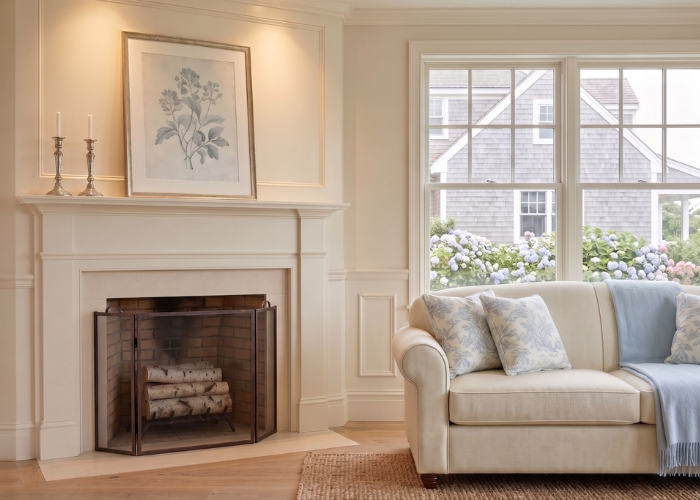
2. Choose a deep sofa with a soft, rounded arm
Shape matters here more than anything else. The seating in these films is nearly always a classic English silhouette: a rolled or gently sloping arm, a generous seat depth, a low back and turned or tapered wooden feet.
The Atworth Sofa is built on exactly that shape, with sloping arms and classic turned wood feet. The Amesbury, with its gently splayed arms and piping, is our take on a British classic and works beautifully in the same room. If your living room leans more period, the Downton Sofa has pleated arms and ornate feet that would look at home in Rosehill Cottage.
For a fuller comparison of shapes, see our guide to the different types of sofas.
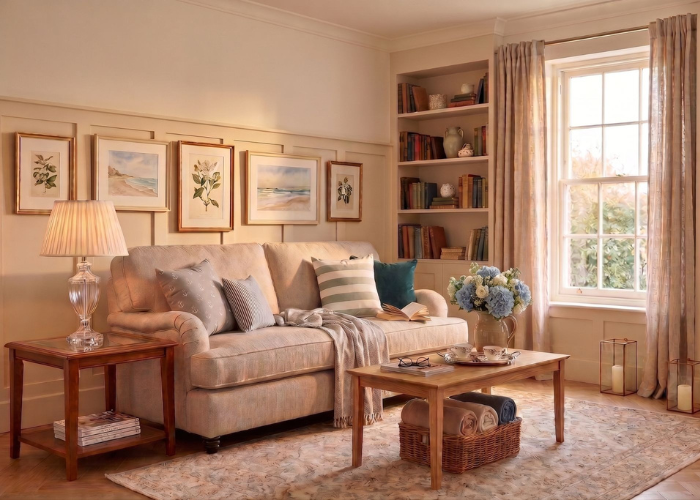
3. Add a second chair that does not match
In the films there is nearly always an armchair that arrived from somewhere else: a different shape, a different fabric, sometimes a different decade.
Pair a neutral sofa with an armchair in a subtly different tone or texture. A cream sofa with an armchair in a soft stone chenille. A sand weave sofa with a chair in a muted botanical print.
Our Langridge Armchair has round, flared arms and piping that give it a classic British character, and it works as a deliberate counterpoint rather than a match. Order a few free fabric samples and lay them side by side in your own light before you decide.
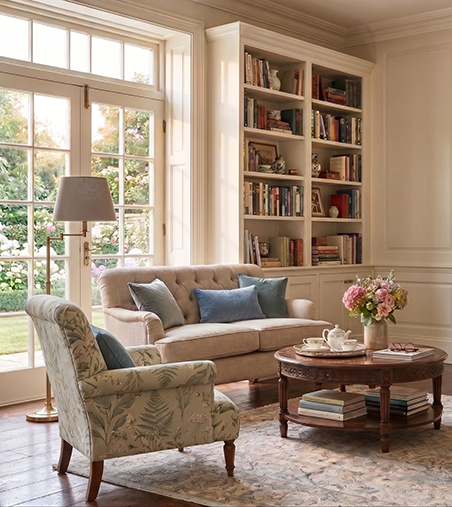
4. Put something natural on the floor
Jute, sisal and seagrass add texture, take the echo out of a hard floor and warm up a neutral scheme. In Something's Gotta Give, the blue and white striped dhurrie in the living room was cut down and restitched from a single 70 foot antique original.
Buy bigger than feels sensible. The front legs of every seat should sit on the rug, otherwise the furniture looks as though it is floating. In a smaller living room, one large rug will make the space feel wider than several small ones.
5. Turn off the big light
Use table lamps with fabric or pleated shades, a picture light over a painting, a reading lamp beside a chair, candles on the mantelpiece. Aim for at least three light sources, put as many as you can on dimmers, and stick to warm bulbs around 2,700K.
If your room is north facing or short on windows, our guide on how to make a dark room brighter covers the rest.
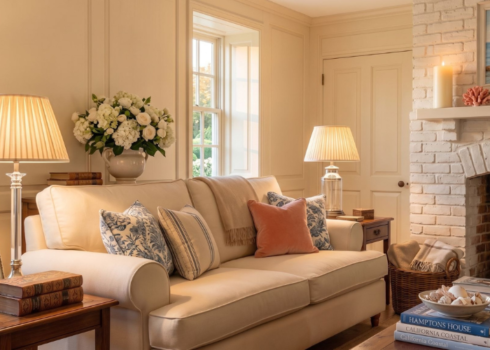
6. Give books somewhere to live
Books are the single most reliable shortcut in Nancy Meyers interior design. Built in shelving flanking a chimney breast is the classic move, and it happens to suit British houses perfectly, a Victorian or Edwardian reception room usually comes with two ready made alcoves either side of the fireplace.
Stack some horizontally, some vertically. Leave gaps. Slot in a photograph, a bowl, a small painting propped rather than hung. If joinery is not on the cards, a console table behind the sofa or a low sideboard will hold a run of books just as happily.
7. Introduce a footstool
A large upholstered footstool or ottoman in the middle of the room is one of the quickest ways to soften a living room and make it feel like somewhere you can put your feet up.
Choose one in the same fabric family as the sofa but not an identical match, top it with a wooden or rattan tray so it still works as a surface, and you have seating, a footrest and a table in one.
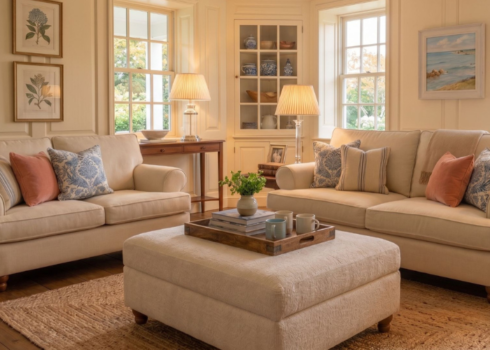
8. Leave things out on the coffee table
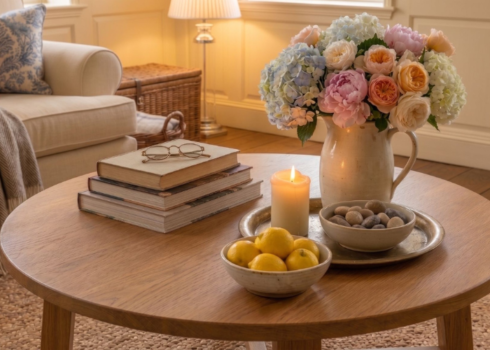
The coffee table in a Nancy Meyers living room is never bare and never perfectly composed. There is a stack of books with something resting on top, a small tray, a candle, flowers, perhaps a pair of reading glasses. It looks arranged in the way a room looks arranged after a good weekend, not after a photoshoot.
The rule of three is a useful crutch here: group objects in odd numbers, vary the heights, and leave some empty table. Our guide on how to style a coffee table breaks it down properly.
9. Mix old with new
Every one of these film interiors mixes periods: an antique settee against a modern sofa, a flea market lamp on a contemporary console, a gilt mirror over a plain mantelpiece. The simplest way to do it at home is to buy the upholstery new and find everything else secondhand. The side table, the mirror, the lamp base and the picture frames are where the age comes from.
10. Allow yourself one pattern
The Nancy Meyers aesthetic is not colourless, it is restrained. There is usually one pattern in the room and no more: a blue and white stripe, a faded botanical, a small check on a cushion or a lampshade. Keep everything else plain and that single pattern will do all the work.
11. Put real flowers in a jug
Hydrangeas, peonies, garden roses, or a fistful of whatever is in the garden. Not a styled arrangement, and not a vase that is trying too hard. A ceramic jug or pitcher, slightly too full, sitting on a table where you will actually see it.
It is the smallest of these Nancy Meyers living room ideas and the one that does the most for very little money. Add a bowl of lemons or apples, a candle that has clearly been lit before, and a throw that has been used rather than draped, and the room stops looking like a showroom.
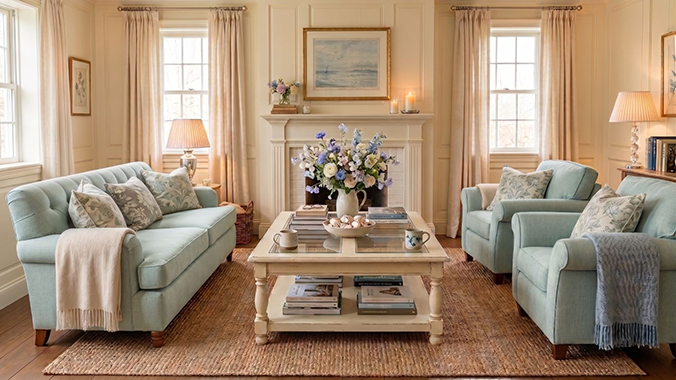
12. Arrange the room for conversation, not for the television
In these films the seating faces itself. Two sofas opposite one another, or a sofa and two chairs around a fireplace, with the coffee table close enough that everyone can reach it. The television is there, but the room is not built around it.
In most living rooms that means angling the main sofa towards the chimney breast rather than flat against the longest wall, leaving enough space to walk between the seating and the table, and accepting that the television may need to live to one side or in an alcove. If your room has an awkward corner to solve, we have six ideas for decorating the corner of a living room.
Making Nancy Meyers Interior Design Work in a British Home
This look was built for large, bright, open plan houses. Most of us are working with something different, so here is how to translate it.
- North facing rooms. Cool light drains the warmth out of pale colours, which is how a beautiful cream ends up looking grey on the wall. Go warmer than you think you need to, test large samples on more than one wall at different times of day, and warm the room with lamplight, timber and textiles rather than more white.
- Narrow rooms. A 3.5 metre wide living room cannot take two facing three seaters. Use one generous sofa, one armchair and a footstool instead of a coffee table, and keep the legs visible rather than skirted to the floor, because seeing the floor beneath makes a room feel larger.
- Chimney breasts and alcoves. Treat the alcoves as the built in bookshelves the films always have, and paint the joinery the same colour as the walls so it stays part of the room.
- Bay windows. A bay is the closest thing most homes have to the light filled corner in Something's Gotta Give. Put a chair in it, not storage.
- Real life, with children and dogs. Cream upholstery and family life are not incompatible, but the specification matters. Our Signature Collection fabrics have built in stain resistance and a high rub count, and any of our sofas can be ordered in a hardwearing weave.
Choosing the Right Sofa for a Nancy Meyers Living Room
Four things decide whether a sofa lands this look: the arm, the seat depth, the cushion filling and the fabric. A rolled or gently sloping arm gives you the softness it depends on, while a hard square arm will read as contemporary whatever fabric you put on it. The Atworth, Amesbury, Chilmark and Buttermere all sit in this family, and the slimmer armed Foxham works where space is tight.
Go as deep in the seat as the room allows. Reflex foam holds a crisp shape and needs no plumping, fibre filled is softer, and feather wrapped foam gives you that sunk in look you see on screen but needs plumping after every use. For fabric, matt weaves, cottons and chenilles in Oatmeal, Oyster, Oat, Fawn, Meadow or Earth sit at the heart of this palette, and every design in our sofas and armchairs range comes in over 150 of them.
If the living room doubles as a spare room, our sofa beds come in the same shapes and fabrics. Modular designs work well here too, letting you add or reconfigure pieces over time.
Bring the Nancy Meyers Look Home with Willow & Hall
What makes this look last is that nothing in it is disposable. A sofa in a warm neutral you will still want in ten years, an armchair that softens with use, a footstool that gets sat on as often as it gets looked at. Pieces chosen once and kept, which is how we have always made furniture.
Every one of our sofas, sofa beds, armchairs and footstools is made to order by hand in our Wiltshire workshop, in your choice of over 150 fabrics, with a 25 year guarantee on the wood frame. You choose the size, the shape, the cushion filling and the finish, so the piece is made for your room.