

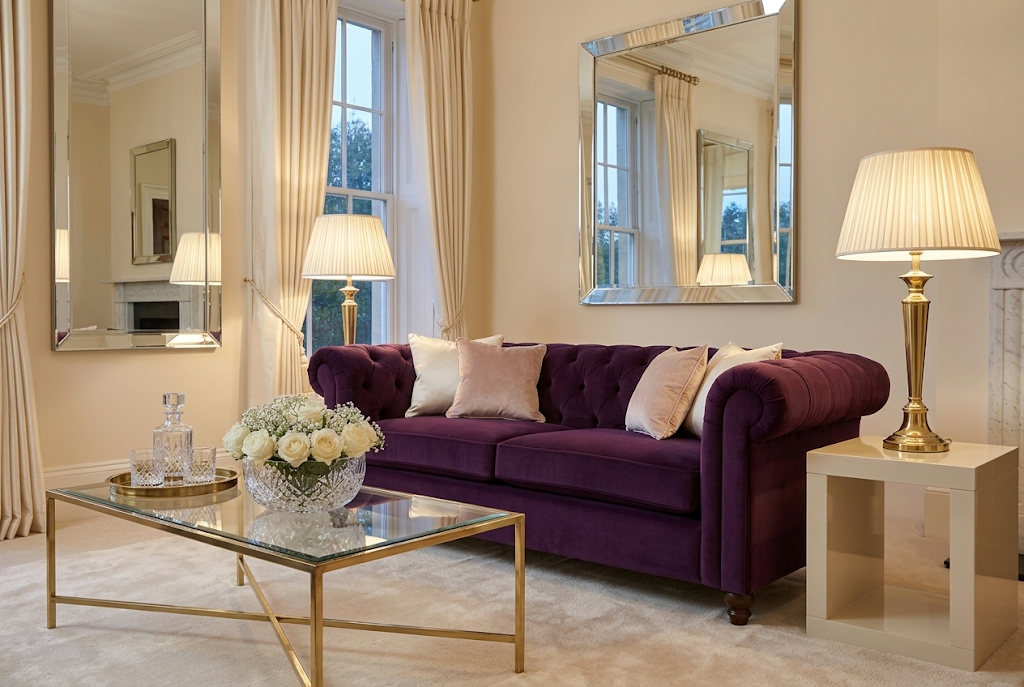
The best 80s interior design ideas capture the decade's bold spirit without copying it completely. Think soft peach and mauve walls, floral patterns, touches of brass or glass, and a big, comfortable sofa at the heart of the room.
For years, the 80s was the decade we loved to laugh at (anyone who remembers a swagged festoon blind will know why). But now, its influence is returning with rounded, cushy furniture and a new appreciation for floral prints and velvet.
In this article, we’ll explain the basics of 80s interior design and share ten ideas you can use in your living room and bedroom. We’ll also offer advice on choosing the perfect sofa to finish the look.
What Is 80s Interior Design?
80s interior design didn’t follow one style. The decade went in many directions, all connected by a love for boldness and plenty of flair.
Postmodernism set the tone early on. In 1981, Ettore Sottsass and his team introduced the first Memphis collection in Milan, mixing bold colours, terrazzo patterns, and unusual shapes. The group ended in 1987, but their style inspired collectors like Karl Lagerfeld and David Bowie.
At the other end of the scale, Laura Ashley’s English country style featured ruffled floral patterns on everything from curtains to sofas, with chintz becoming a symbol of the look. You can read more about it in our guide to English country interior design.
Those who preferred a sleeker look chose glass-block walls and polished chrome. TV shows like Dynasty made mirrored walls and velvet sofas the ultimate in glamour.
Colour brought all these styles together. Early 80s rooms featured soft pastels like peach, mauve, dusty pink, and seafoam green. Later, bold teal and pink shades inspired by Miami Vice became popular. Houseplants, especially Swiss cheese plants, added a touch of green to almost every living room.
Ten 80s Interior Design Ideas for Living Rooms and Bedrooms
You don't need to recreate the whole decade to enjoy it. Our 80s living room ideas start in the room you spend most of your time in, then move through to the bedroom.
1. Start Your 80s Palette With Peach and Mauve
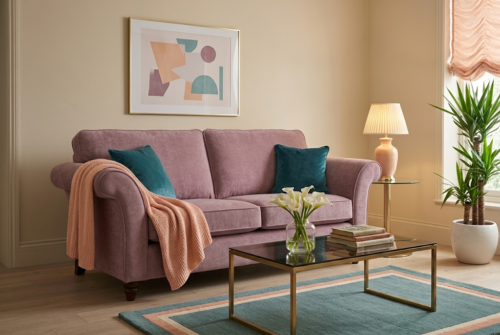
Pastels defined the early 80s, and they're back in chalkier, more grown-up versions. An 80s living room doesn't need to be pink from skirting board to ceiling, though. Try a soft peach or mauve on the walls, or colour drench a smaller snug for a cocooning feel.
If your walls are staying white or magnolia, the sofa is where the pink can go. Our Eco Chenille in Mauve or Antique Rose has the soft, slightly dusty colour of the decade, and it looks at its warmest under a table lamp in the evening. For something deeper, Deep Velvet in Woodrose gives you a richer pink. A plum cushion or a teal rug at its feet stops all that pink from tipping into sugary.
2. Make the Sofa the Star of Your 80s Living Room
If one piece of furniture sums up the decade, it's the big, sink-in sofa. 80s seating was generous and made for lounging, and today's version keeps that comfort with cleaner lines.
Look for deep seats and plump back cushions, and choose a size that anchors the room rather than a token two-seater lost against the wall. Placing it to face the room's focal point, rather than pushed back against the longest wall, gives it the sociable feel 80s living rooms were built around.
Because every one of our luxury sofas is made to order, you can choose the size that suits your room, not the one a showroom happens to stock.
3. Recreate the Conversation Pit With Modular Seating
The sunken conversation pit began life in 1950s homes such as Eero Saarinen's Miller House in Indiana. By the 80s, it had evolved into low, modular seating arranged around a central coffee table, and it's still the layout many of us picture when we think of an 80s living room.
You can recreate that sociable, enclosed feel without digging up the floor. Arrange modular sofa sections in a U or L shape, keeping them low and deep, with plenty of cushions. The Deverill and the Ablington both reconfigure easily, and our guide to modular sofas explains how the pieces fit together.
4. Go for Chintz, But Keep It Fresh
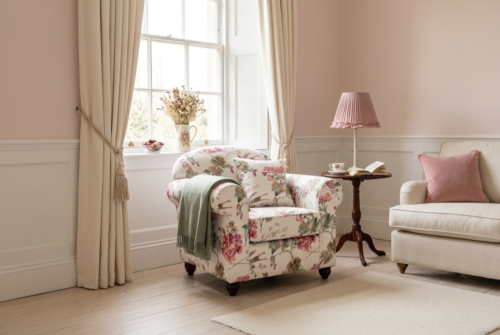
In a typical Laura Ashley room, the same rose print ran across the wallpaper, curtains, cushions and sofa, so the eye had nowhere to rest. Today, those florals look fresher on a single armchair, with plain walls and a calmer sofa around it. Place it by the window, where you might sit to read, and daylight will bring out the print's detail. In a smaller room, love seat in the same print does a similar job.
Our Garden Print and Botanical Print fabrics are made for this. Blossom and Bloom lean into the rosy pinks of the era, while Haven and Serenade bring in soft teal and lilac tones. Pick out one colour from the print and repeat it in a cushion or throw to tie the room together. You can request the prints as free samples to see the detail up close.
5. Channel 80s Glamour With Velvet and Button-Back Detail
Deep velvet in rich colours, finished with plenty of buttoning, was the height of 80s luxury. Velvet catches the light as you move, which is why it still feels so luxurious.
For the full effect, choose a button-back sofa with scroll arms in a jewel tone, such as Vintage Velvet in Jade or Deep Velvet in Plum. The Bulford, with its deep-diamond buttoning, is our grandest option, while the Foxcote brings button-back detail to a smaller room.
If velvet feels too formal, chenille gives a softer, more relaxed take on the same vintage look. For more, see our round-up of button-back designs and the pros and cons of velvet sofas.
6. Add Shine With Brass, Chrome, Glass and Mirrors
Reflective surfaces were everywhere in the 80s, from mirrored walls to chrome-legged chairs, and they're one of the easiest 80s living room ideas to borrow. Use them with restraint, though. Choose one metal and repeat it a couple of times, in a lamp base and a picture frame, say. Brass warms up pastels and pinks, while chrome suits cooler schemes and the black-and-white of the late 80s.
Hang a large mirror opposite the window, and it will throw daylight back across a north-facing room. For a more obviously 80s touch, a short run of glass blocks lets light into a dark hallway while keeping it private. Set all that shine against soft upholstery to keep the room cosy.
7. Play With Memphis-Inspired Shape and Pattern
Memphis design is all squiggles and zigzags in clashing primary colours, much of it drawn by designers such as Nathalie Du Pasquier. It's a lot to live with every day, so bring it in through pieces that are easy to change. A geometric rug or a set of graphic cushions gives you the style's energy without the commitment.
Keep the sofa a calm, solid colour so the pattern has room to play, and use our guide to how to dress a sofa to get the cushion mix right. A footstool in an unexpected colour, such as Vintage Velvet in Mustard, is a low-risk way to add a playful Memphis note.
8. Make the Headboard Your 80s Bedroom Statement
80s bedrooms loved a padded headboard, often ruched or buttoned and covered in fabric to match the curtains. It's still one of the simplest 80s interior design ideas for the bedroom, because it changes the feel of the whole room without redecorating.
An upholstered headboard in a floral print or pastel velvet brings the era in straight away. Keep the bedding simpler so the headboard takes centre stage, perhaps plain white or a colour drawn from the print.
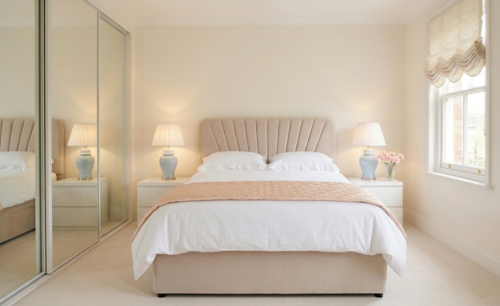
9. Layer Florals and Frills for a Softer Kind of Matching
The classic 80s bedroom matched everything, with the same print on the curtains, duvet, valance and lampshades. To update it, coordinate instead of matching. Use one print on the headboard or bed, then echo it once elsewhere, perhaps in a pair of swagged curtains or a single cushion. A frilled pillowcase nods to Laura Ashley without going all in.
At the foot of the bed, a velvet ottoman adds useful storage and a softer finish. For more pattern-friendly inspiration, see our country bedroom ideas.
10. Bring Back the 80s Indoor Jungle
No 80s home was complete without a Swiss cheese plant. Yuccas, rubber plants, spider plants and Boston ferns filled living rooms and bedrooms alike, often in cane or rattan stands.
Go large rather than dainty: one tall plant beside the sofa has far more impact than a row of small pots. Add a trailing plant on a shelf and a rattan planter, and the greenery will beautifully soften pastel schemes and brass accents. Plants are also a clever way to fill an awkward space, as we explain in our guide to decorating a living room corner.
How to Get the 80s Look Without It Feeling Dated
Making 80s interior design ideas work today comes down to editing. Pick one or two statements per room, perhaps a printed armchair and a brass lamp, rather than working through every one of these 80s living room ideas. Keep walls and floors calm so those pieces stand out, and mix in natural materials such as wood and rattan to soften the look.
Above all, choose a sofa shape that will last and let the fabric carry the era. That's where made-to-order makes a difference: you choose the exact fabric and filling, so the result feels tailored to your home rather than like a costume. If your taste moves on, new cushions and curtains can take the room in a fresh direction while the sofa stays.
How to Choose a Sofa for an 80s Living Room
If you're buying a sofa with the 80s in mind, these are the choices we'd talk you through.
- Shape: For the Dynasty end of the decade, the Bulford's deep-diamond buttoning and scroll arms do most of the work before you've added a single cushion. For a conversation-pit layout, the Deverill's separate sections can be pulled into a U around the coffee table.
- Fabric: Velvet looks lighter or darker depending on which way the pile lies, so a Deep Velvet sofa seems to shift colour as you walk past it. That's a big part of its 80s appeal. Floral prints are a braver choice on a whole sofa, and most rooms carry them better on an armchair.
- Filling: Feather-wrapped foam gives you the sink-in feel of an 80s sofa. The cushions need a daily plump, but that slightly lived-in look is part of the charm. Reflex foam keeps a crisper edge, which suits a tailored button-back.
- Size: Measure the hallway and doorways as well as the room, because a generous sofa is no use if it can't get past the stairs. Our guide to measuring a sofa walks you through it. In a smaller living room, a love seat gives you the look without crowding the space. If you also need somewhere for guests to sleep, a sofa bed with a real 14cm-deep mattress sleeps as well as it sits.
Every frame is hand-built from sustainably sourced timber and comes with a 25-year guarantee. If you're torn between Mauve and Antique Rose, or between a print and a plain, order up to eight free fabric samples, pin them to the back of your current sofa and look at them morning and evening.
FAQs
What colours were popular in 1980s interior design?
The early 80s favoured pastels such as peach, mauve, dusty pink and seafoam green. Teal and pink took over in the middle of the decade, and neon brights with black and white arrived later. There was no official colour of the year then, as Pantone didn't start naming one until 2000.
What is 80s interior design called?
There isn't one name, because the decade mixed several styles. Postmodernism and the Memphis style are the best known, but English country and high-tech interiors were just as popular.
What furniture was popular in an 80s living room?
Big, deep sofas and modular seating sat at the heart of the room, alongside glass-and-brass coffee tables and rattan or cane pieces.
How do you make an 80s bedroom feel modern?
Choose one statement, such as a printed or velvet headboard, and keep everything else calm. Simple bedding and a soft wall colour will stop it feeling like a period piece.